Monday, 16 June 2014

Binchester 2014: Days 5/6

Apologies for the lack of a blog entry on Friday – circumstances conspired against me. Today has been about walls – new back walls, newly revealed walls where we weren’t expecting them and new fort walls.

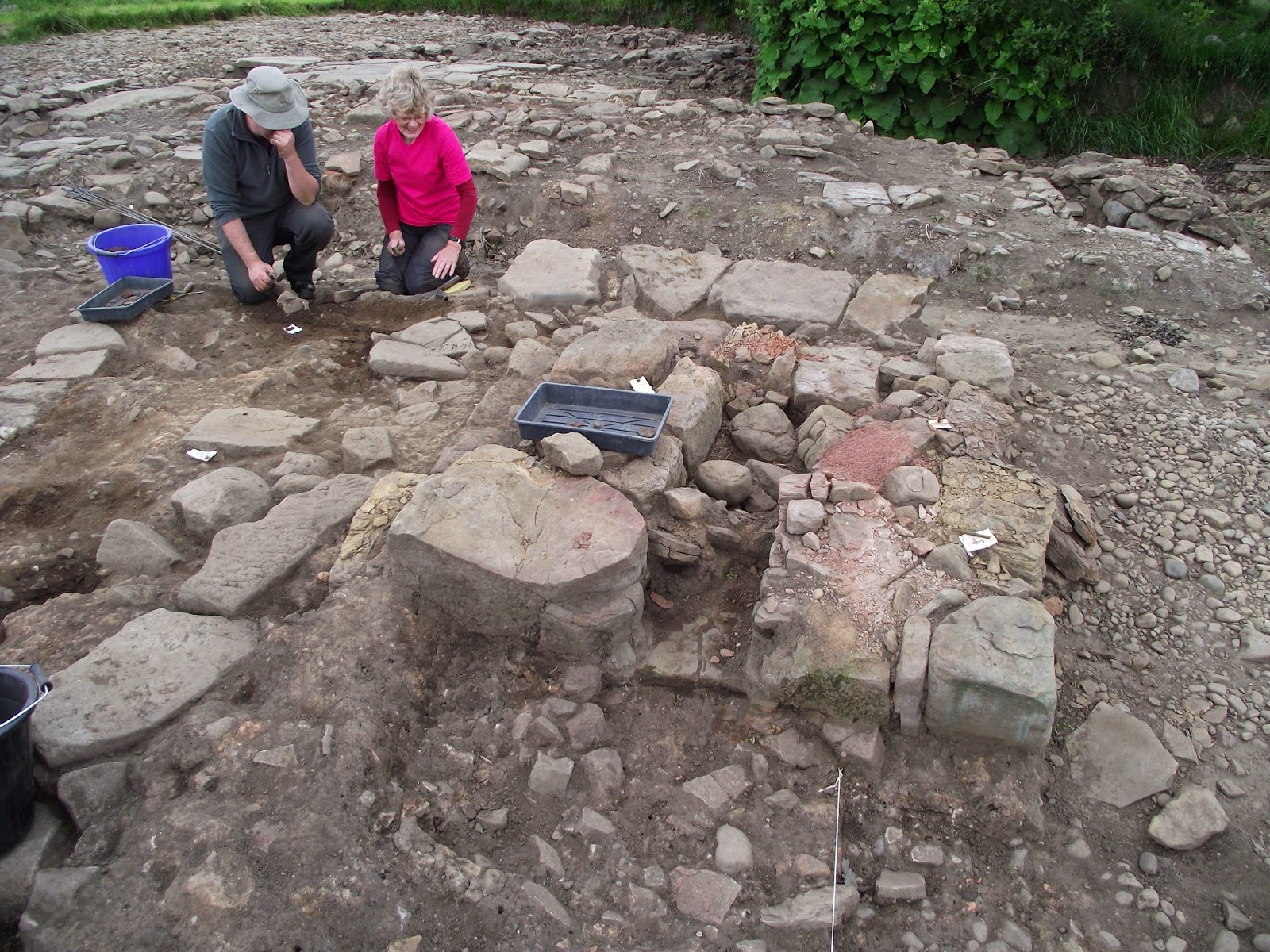
In Trench 1 we’ve been working away at a series of locations on the northern and eastern rampart. In the north-west corner of our trench, we extended a slot northwards to try and pick up the fort wall. We had a rough idea of its alignment as we have already seen it forming the back wall of the latrine block. Pleasingly, in our new slot it was where we expected – we also picked up the back wall of what we had suggested was a tower. It in fact looks more like a stone structure surrounding an oven on three sides. In the corner of the trench, the students have done a stirling job pulling back the section edge and revealing the inner face of the robbed out wall. It now looks like they may have picked up the southern wall of the corner turret. We will need to make one more tiny bite extending the trench to pick up where this return wall runs back into the main wall alignment. Finally, southwards along the eastern rampart, we ran another prospecting slot out from the main trench to pick up the fort wall on this edge. Surprisingly, the extent of open space/rampart between the intra-vallum road and the wall is much more substantial than on the north side, with nearly 3 metres of blank space on the berm. Put together, our cheeky trench extensions mean we have now picked up the wall on both our ramparts as well as where it meets the fort corner turret.

Elsewhere the focus in Trench 1 has been on picking apart the floor surfaces in the barrack interior. We’re starting to find a range of metalled surfaces at various places within the barrack. We have also identified a number of possible cut features – post holes, gullies etc. Some of turned out to be convincing on full excavation, others less so… Nice finds include a small penannular brooch (possibly Type D – although I’ll need to check my brooch typologies….) found by Tudor in the stable area of the northern compartment.

In Trench 2, inevitably there has been much work on the bath-house interior. In the main room, the students have done stirling work taking the section back and clearing up the new northern wall of the room, which had previously been glimpsed when the altars came out. Although they have not revealed all of it, we have seen enough to know it contains a blocked doorway. On the other side of the main room, there has been continued work removing the big dark refuse deposit. Pleasingly, we are now coming down in places onto the benches that ran round the interior of this room. Progress has slowed slightly though as we’ve hit a more clayey layer which will need to be treated as a separate context. In the smaller room, we’ve decided to put a slot through the refuse deposits running from the southern end of the square annexe to the doorway. This will allow us to work quickly through the deposits without getting caught up too much with removing stone surfaces which mainly lie on the other side of the space. We’ve also made an executive decision to pull the trench out slightly to the east to just allow us (we hope) to catch the eastern end of the southern annexe, which is currently just beyond our trench edge.

Outside the bath-house life is getting more exciting. Abbey and Nicole have taken out a baulk we’d been keeping in to allow access in and out the trench and we’ve rerouted our barrow runs. This means we now have a clear view of all the exterior of the bath-house. To the west of this , in the area where we’ve been exploring the possibility of a new strip building we have indeed found a new wall. However, if this is part of a strip building it would make it much longer than our others and continues beneath the northern edge of the trench – nor is there, as yet any sign of another paired wall which we’d expect to find. I just wonder whether it might in fact be defining an exercise yard area adjacent to the bath building. Finally, we are revisiting one of our certain strip buildings. Here it is clear that the kiln or oven is much larger than we appreciated (or we have two phased ovens). The new area is less well preserved than the main oven we uncovered in earlier seasons.
Tomorrow, more bath-house clearing and wall cleaning…and just possibly a little laser scanning!

Thursday, 12 June 2014

Binchester 2014: Day Four

I was off site most of the day - but thanks to some of our year 1 students for providing some commentary

From Trench 1 Kerry Edwards reports:
"Today, in trench one, the majority of the team approached, with vigour, the main barrack blocks. They began to remove the soil deposits in an attempt to find further floor surfaces. So far this has revealed cobbled surfaces in two areas and in the meantime, a silver coin has been found, as well as many copper pieces.

Elsewhere, in the corner of the fort, work continues on the possible corner tower and curtain wall, where the full extent of the walls are slowly being revealed. Along the West side of the trench, the cobbled surfaces are being cleaned.

However, interestingly, the North East area, a group of students spent the day searching for the outer wall of the fort by extending the trench a few meters back and as a result have come across a wall which could potentially be a free standing building, possibly connected to the fort oven but not connected to the main fort wall. Other interpretations of this wall suggest it could be an interval tower. They have also managed to find the exterior wall of the trench successfully, and are going on to reveal it further.

Elsewhere in Trench one, physical activity has been taking a back burner and instead the recording equipment has been dusted off and rejuvenated. A group of students spent the morning recording the dumpy level and line levels of a few suspected features, including: two suspected post holes, a peculiar pit and a slightly awkward cobbled surface. In the North West of the trench where the cobbled surface lies, they went on to remove the stones in order to excavate the earlier levels."

Meanwhile our Trench 2 correspondent Naomi Ireland-Jones says

"A slightly cooler day today, the majority of interesting finds from trench 2 continued to come from the metal detectorists covering the spoil heaps rather than from those excavating in the trench. However it is always nice to hear that there is a coin in your spoil and we had several today. A lead weight was another interesting metallic find. It might sound rather silly, but it's incredible how heavy lead is. Being so used to our light alloys in coins to pick up something around the size of a 50p but for it to weight the equivalent of probably 2 £1 coins is quite a strange sensation!

Further finds of the day included two more hair pins, one of jet and one possibly of bone. Both of those came from the dump in the Bath House, so are likely to be later in date. Someone also had the excitement of finding an almost complete pot: whether it was more complete before they found it I never found out, but it's certainly something to get more excited about than the considerable quantities of fragmentary animal bone we've been finding everywhere!

Personally, my moment of the day was when we finally got round to removing the tarpaulin which marks the bottom of last years excavation in the bath house, but maybe that's me! No altars so far, but we'll be sure to be yelling it to everyone if we do find one!"

Wednesday, 11 June 2014

Binchester 2014: Day Three

Good day on site today – the numbers of people out at the moment really make a difference when it comes to the amount of work that gets done.
In Trench 1, the ‘grunt’ work in extending the trench slightly in places is paying off. In the corner turret area the wall is starting to come out quite nicely, although the internal facing stones seems to be robbed out. We opened up a new extension today in the north-east corner of the trench to try and better understand the small stump of wall that has sat there for five seasons now. We’ve always assumed this was part of a small turret, but we need to clarify this. In the course of this, Megan found a nice circular copper alloy brooch with traces of red enamelling still visible. On the eastern rampart, a series of what we thought might be post-holes disappeared into nothingness although the rampart itself is clearly visible. In the barrack itself, we are taking out the final elements of the later phases and starting to get a better understanding of the building interior. We need to make some big decisions about what elements of the building we want to dismantle before we can go much further. To the west of the barrack, the nice cobbled surface has come through very nicely whilst to the east, the volunteers are making great strides in taking down the road section they are looking at.

In Trench 2, the interior fill of the main bath-house room is slowly but surely receding. The collapse from the altar removal has now all gone and they students are starting to move sideways into the section to catch the back wall that was partially exposed when the altars were removed. In the process of this work they came across a really nice cache of butchered cattle bone. Elsewhere in his room, a possible clay layer is emerging from within the dark fill. It is difficult to tell whether this is going to be a coherent deposit or simply a clay lens within the larger dump. The fill between the main room and the annexe has also now gone leaving just a small dump of stones partially blocking the threshold. In the corridor, the students have finished cleaning back the complex of secondary stone structures, clearly showing a paved path leading towards the doorway in the cross-wall. It looks like these flags have been laid down on top of an initial deposit of refuse to facilitate movement towards the door where seemingly more rubbish was dumped.

The stones from the larger post-pad building are now more or less completely removed, leaving just a small number overlying the north wall of the earlier structure. We got a nice assemblage of what looks like Crambeck parchment ware from this area.


Finally, we’ve been having a good look at the ‘empty’ area to the west of the bath-house - we are starting to think that there may actually be another strip building here, although a poorly preserved one. This would mean the side road between the previous strip building and the bath-house is smaller, but I think, more convincing.


Binchester T-shirts

This is your chance to share your opinion on the this year's Binchester t-shirt designs. I've put the various images up- please let me know which you prefer (judges decision is final....)

Tuesday, 10 June 2014

Binchester 2014: Day Two

Although only on day two we are back in the swing of things. Today we were joined by our local volunteers – it was good to see so many familiar faces back on site. Overall we had nearly eighty people in the trenches, so we are moving full steam ahead.

In Trench 1, the new expanded areas of trench exploring the ramparts are moving well. In the eastern edge of the trench, the team has come down onto the rampart itself already, although there is no sign of the fort wall. In the corner of the trench, we’ve hit the wall, or at least it’s interior edge and the rubble core, which is currently being cleaned. Within the barrack itself, we’re having a good clean up in expectation of some overnight rain. We need to make some big decisions about how much of the structure we can begin to dismantle before we get much further. Some nice finds coming out including a carnelian intaglio. To the east of the barrack we are also starting to put a wide slot through the intra-vallum roadway to get a sense of its depth and longevity. On the other side of the barrack, we’ve located a rough surface or wall which needs to be cleaned and recorded

In Trench 2, progress has been equally rapid. Within the large bath-house room, nearly all the backfill from the altar excavations has been removed, with some nice finds coming out including several coins and a bone counter. On the other side of the room, the possible crude stone layer within the refuse deposit did not turn out to be very big and it has been removed and much more of the dark deposit taken up - lots of bone and a nice jet pin. It is now possible to see the base of the window in the wall face. Quite a bit of wall plaster is visible in situ, some seemingly painted red. In the small annexe, where we thought we saw steps yesterday, it turns out that we had just one step down into the structure itself and then a flat stone floor, which was cleaned and photographed. We have now started work removing the deposits that block the door from the annexe into the large room itself. Next door in the corridor, we’ve got clear evidence of some rough internal structures built into the backfill- including a possible stretch of drystone walling and a possible path or surface.

Outside the bath-house, we have begun to take apart the two post-pad buildings- the larger stones that formed the base of the second (later) structure are starting to go. We’ll soon have the smaller, earlier structure, fully exposed, with all its floors more or less intact. Finally, various groups are cleaning up the side alley that runs along the west side of the bath-house. Inevitably, today’s nicest find was from the spoilheap…a rather tasy, probably silver, ring with an intaglio set in it. This is the second ring with in situ intaglio found in our campaign of work at Binchester!


Monday, 9 June 2014

Binchester 2014: Day One

In Trench 1, our groups were attacking various areas around the edge of the trench. We’ve expanded our trench in two places in an attempt to catch the outer wall of the fort, particularly on the east side. So far, we’ve mainly been moving turf and topsoil, but we are keeping our fingers crossed that the walls come through soon. Elsewhere, on the north side of the trench, we’ve got a group of students cutting back a small surviving area of overburden to get a better understanding of the interior side of the rampart in this area. No significant results so far, but plenty of finds including Roman glass, pottery and animal bone is being revealed. Finally, on the western side of the main barrack building, a group is cutting back the layers and is coming down onto a patch of stones, possibly a crude wall or stone surface. Again, we’ve had some nice finds here including a copper alloy stud. More generally, Peter, Matt and myself have been having a good look at the barrack block – we are tentatively wondering whether we can see another similar discrete compartment, similar to the decurions quarters. Have we got ‘chalets’? Difficult to say at this stage, and much will depend on improving our understanding of the phasing.

In Trench 2 we’ve been throwing people at the main bath-house. This week we are without our usual trench supervisor Jamie, as he is on paternity leave dealing with his new ‘small find’. However, Natalie, Bekka and Tudor are doing a great job. Inside the large room, we’ve got a number of students clearing up the mess left by the removal of the altars at the end of last year. This involves bucketing away the collapsed deposits left by the digger- its frustrating clearing an area that has previously been cleared, but we are making great progress. At the other end of the same room, we’ve been cutting back the dark fill and, inevitably, hit another layer of stones, although we have also revealed some nice wall plaster and op sig. In the small annexe structure adjacent to the external door for the changing room, the excavators have found an area of flooring across half the area and it is possible we may also have some steps leading from roughly street level into the room. This is the first information we’ve been able to gather about how our basement rooms related to the higher street level. In the adjacent corridor we’re also slowly moving the interior fill- lots of stone and lots of bone! To the south of the bath-house, the students are clearing the interior of the post-pad buildings – it looks like they are coming down onto a nice clay surface that may make up much of the interior flooring of the structure. Finally, to the west, a small crew are dismantling a large stone spread, which includes a section of a worked plinth or panel.

We got away lightly with the weather today – some heavy rain over lunch, but it cleared up fairly quickly and we stayed on site for the rest of the day.


Wednesday, 14 May 2014

Come and dig at Binchester

We've always prided ourselves on the fact that we've had great involvement from local volunteers helping us out on site during our excavation season and back in our labs with the post-excavation work. If you would like to come out and help us on site and gain experience excavating a Roman fort we still have places available from Tuesday 10 June to Friday 25 July (weekdays only). If you are interested please contact David Mason (david.mason AT durham.gov.uk)