Thursday, 4 July 2013

Binchester 2013: Day Nineteen

A hectic day today as we had to deal with all the fallout from the press release about the carved head, which ranged from the sensible to the more eccentric. Consequently I had to do quite a few interviews and deal with the 'Geordie God' issue! Despite all this excitement, progress on site today carried on although with no major development. Trench 1 saw the big pit (now officially "Jonathan's Pit" continue to puzzle and confuse, whilst nearby Karen persevered with the gully. Rachael's bread oven is emerging nicely although it doesn't seem to have the superstructure that survives on the other one. Lots of work carried on down both sides of the main barrack block and one of the small pits at the south end is turning into a slightly more substantial feature! In Trench 2, more general earth moving, although we saw some recording going on in and around the post pad building. Progress continued with the section of the corridor north of the dividing wall. Pleasingly no new stone layers have emerged yet- if this carries on we stand a chance of clearing out this entire section before the end of the season. Whether these structural remains turn out to be a cellar/basement or simply terraced into the hillside (although the difference is a moot ne) they are going to be impressive and we need to think carefully about how they will be conserved. Several nice finds today- a lovely key handle, a shale bangle fragment and nice bone pin!

Wednesday, 3 July 2013

Come and see the Binchester stone head!

For those of you who've been reading or hearing about the Binchester stone head why not come and see if for yourselves? It will be on display at our event on Saturday and Sunday July 13-14 held a part of the National Festival of British Archaeology. As well as seeing some of our finds including the head, there will be site tours to learn about new discoveries made during this year's excavations at the fort. Roman re-enactors Roma Antiqua are joined by a detachment of Legio IX and Barbaratus the Roman cavalryman to counter attacks by the Celts and the Nordmanni (Saxon and Viking Living History group). You can also visit the tented encampment of Roman soldiers and civilian traders. Click here for information about how to find the site, admission charges and other information about visiting Binchester Roman fort. If you want to read more about the head itself click here

Binchester 2013: Carved stone head

Many of you may have found your way to this blog as a result of the press coverage we've received about our recent discovery of a carved stone head of an unknown Roman god at Binchester. Inevitably in the various interviews we've done, David Mason and myself have not been able to go into much depth about the find, so I'd thought I'd try and summarise the current state of knowledge about it. The head, which is made of sandstone, was found in a dump of late Roman refuse that had been thrown into one of the rooms of a probable bath-house in the civilian settlement that lies outside the Roman fort at Binchester. This building was terraced into the hillside and all the rooms we've looked at have been filled with massive deposits consisting mainly of alternate layers of butchery waste and rough stone surfaces. These dumps are around 6' in depth. The head was part of one of these stone layers and as such is clearly not in its original context. However, there is reason to belief that it may have originated from this general area. A couple of years ago we found part of an inscription nearby that appears to record the dedication of a small shrine by the commander of the cavalry regiment based at the fort. In the same sequence of late Roman dumping we also found a small Roman altar, and earlier this week we found a fragment of a pot with an applique pottery wheel on it that may have ritual connections to the cult of the Romano-Celtic 'wheel god' perhaps best known from the north of England in his guise as Taranis. This all suggests some ritual activity in the immediate area or more likely within the bathhouse itself. However, at some point, probably by the 4th century, the bath and shrine had fallen out of use and the head ended up incorporated into these waste deposits. The head itself is sandstone and reasonably well carved although not of the highest order of Roman sculpture. This can be seen clearly when compared with its closest parallel, the head of Antenociticus from the Roman fort at Benwell on Hadrian's Wall. The Benwell head is clearly more proficiently carved, but both share the similar hair style and lentoid eyes, although the eyes from the Binchester eyes are far more 'googly'! The Benwell head is also clearly part of a larger statue; parts of the neck survive showing it had been detached from its torso. However, the Binchester head has no neck and no sign of a scar in this area. Instead, it seems to have always been intended to simply be a detached head and its flat base means it sits easily on flat surfaces. A number of people have suggested that it has an African appearance, primarily because of the modelling of the nose and mouth. The lips are certainly fuller than the fairly tight lips of the Antenociticus head. However, it is difficult to be certain how far this was an intentional decision aimed at depicting ethnicity. It is also worth noting that the nose and mouth appear to have been slightly damaged in antiquity, flattening them off slightly. We have canvassed the opinions of various experts opinion has been pretty evenly split. So, do we know who this god was? No - despite the broad similarities with the Antenociticus head, I don't think we can say that the Binchester head is meant to represent him. Nonetheless, they are both clearly drawing on the same broad artistic repertoire that combines both classical and more indigenous Romano-British artistic styles. I am fairly happy that it is meant to represent a local god - although the depictions of local gods in Roman Britain were often conflated or paired with better known Classical deities. As such it is rather fitting that we found the head in the civilian settlement, one of the key arenas in which the Roman Empire through its army and administrators would have come face to face with the native people of Northern England.

Binchester 2013: Aerial-Cam shots

As I mentioned the other day, this week were visited by Adam from Aerial-Cam. He was able to do plenty of his usual high-level shots of the trenches, but was also able to process these shots to provide rectified 3D images of our trenches. We also saw his latest research project, a tiny UAV equipped with video and stills cameras. Below are some of the first products of this activity. I'm particularly excited by the rectified site shots - these are going to be invaluable in recording the site. Enjoy!

Binchester 2013: Day Eighteen

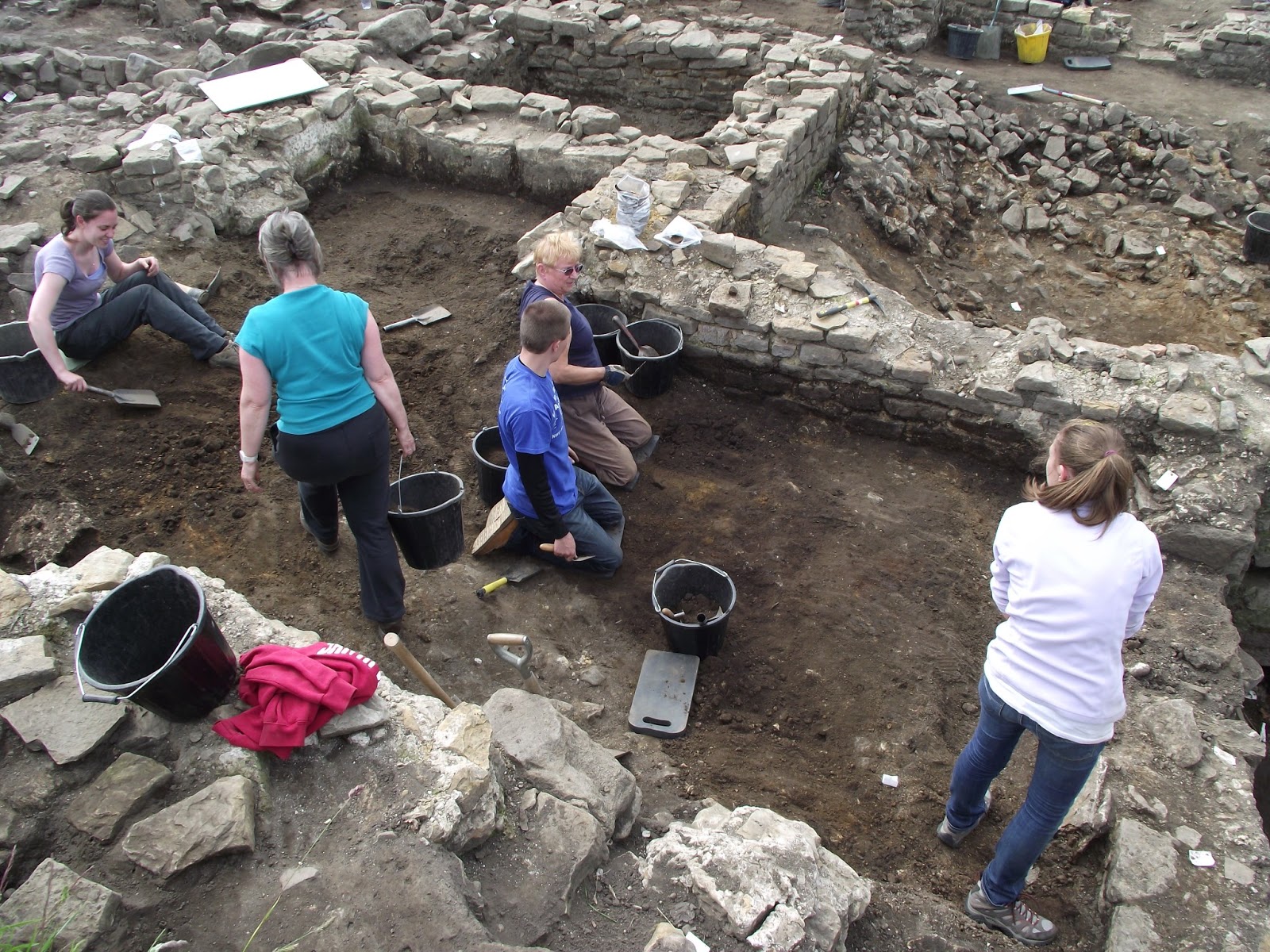
A hectic morning, as we had lots of press visits following a press release about the carved stone head (I'll do a separate blog entry about that shortly). When we finally got going, progress was rapid. In Trench 1, we've begun the great assault on the area to the west of the barrack block. This long strip between the building and the trench edge has not really been touched this year. In the past, we've found a series of hollows and pits containing butchery debris cut into this area. However, we're now trying to move the matrix into which these features were inserted. Inevitably more features are already showing, including what looks like a large charcoal rich pit at the north end (for once, seemingly lacking a stone lining!). We're also working away vigorously in the area to the east of the main block. Although there is a lot of fairly heterogeneous surfaces and cobbles we've started to reveal at least one substantial flagstone floor here. At the north end of the barrack, we've seen more work going on to define the wall underlying the barrack- it's coming up very nicely. In the far north-west corner of the trench Rachael has begun to reveal what looks like another bread oven. We'd been assuming it was an interval tower as it has a small stretch of walling, but it looks like this may have been a superstructure for the oven (which is seemingly less well preserved than the one in the eastern rampart). Meanwhile, work continues in the big pit.... In Trench 2, we've been expanding the trench in the north-east corner - nothing drastic, just a fractional cutting back to improve access to this, our deepest area on site. In the southern compartment of the corridor, all the stones have been cleared revealing a nice seemingly clean brown soil. Will we find yet more stone layers beneath this? Almost certainly. The post-pad house is looking nice and clean- some recording going on- deconstruction will start soon. In the area to the east we've some nice surfaces coming up, but seemingly nothing structural yet.

Tuesday, 2 July 2013

Binchester 2013: Day Seventeen

Good day on site although we had our first real rain of the season, but that didn't stop our dauntless team of diggers. Starting in Trench 1 from my perspective the most interesting development was the emergence of a west-east wall underlying the northern end of the barrack. It appears that it may extend eastwards beyond the main east wall of the current barrack building. It clearly doesn't relate to any part of the current building we are excavating, so may indicate and earlier phase of activity on the site. It might be linked with the short stretch of wall or gully just visible in the base of the large gulley we have incorporating the northern gable wall of the barrack. As elsewhere on site, we are starting to have a real sense of phasing across this part of the site. Nearby, one of our US team found a rather nice jet ring - one of the nicest jet pieces we've had to date. Meanwhile, Karen and Jonathan continued bravely in the big pit; they've got a group of articulated cattle bone, which will be a prime candidate for C14 dating. In Trench 2, we finished cleanig up the interior of the post-pad building and got it photographed; we can start removing stone in this area tomorrow. We've also been cracking along to the west of this building with some interesting surfaces starting to emerge. In the main building, we're in the same old routine of stones and dumps in the big room. Meanwhile in the smaller room, we're taking the trench edge back in one corner for practical reasons and to make sure the area remains safe when we excavate. My favourite development in this area was in the southern compartment of the corridor where we appear to have the abutment and one or two footers of an arch way that appears to have framed an area within the porch forming a large niche and tentatively another feature in a similar position the other side. This makes it pretty certain that the floor surface here must match that in the northern part of the corridor. We have serious structural remains!!

Monday, 1 July 2013

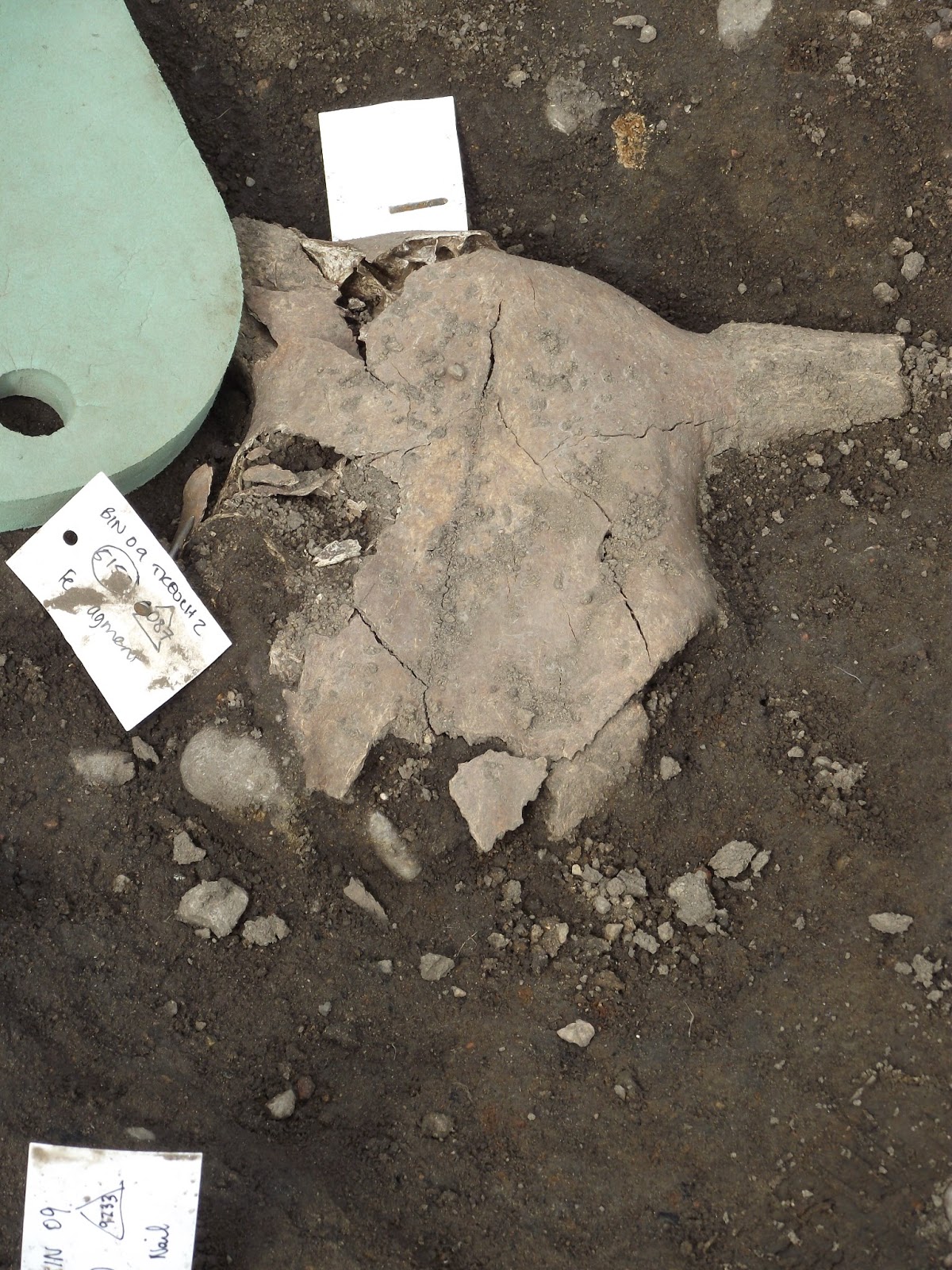
Binchester 2013: Day Sixteen

Back on site after our week's break. We welcomed 40 students from the US and around 25 members of the local community on to site today. This meant we had a really decent sized excavation crew to allow us to crack on with the work we'd begun in June. In Trench 1, most of the activity was focused on cleaning down the interior of the barrack block in both parts of the building. Already making great progress, with new floor surfaces appearing. Near the latrine a new group started exploring the course of the culvert that ran under the latrine- although they are currently focussing on the stretch of it where it entered the big pit. Talking of the big pit, Karen and Jonathan were continuing the epic struggle - today's most intriguing find from this feature was a well preserved human jaw bone. We've actually a small but not insignificant quantity of human bone (all disarticulated and seemingly residual) from this trench. I'd been assuming that some of it had been ploughed out from the known Anglo-Saxon cemetery in the central area of the fort, however, this jaw, from at least four feet down in a pit fill was clearly not derived from this source. In Trench 2, lots more activity in the post-pad building and we're intensifying our focus on the area to the west of this. We're also continuing our push in the section of the corridor to the south of the cross wall- presumably this is going to also show our regular sequence of bone dumps and stone surfaces. In the big room, we began removing the existing layer of stones, to reveal...surprise surprise... a dark layer and more stones! Finally, in the section of the corridor we've already bottomed out, we were focussing on cleaning up and cutting back the section - this is coming out very nicely showing the tip lines of the rubbish dumps quite clearly. I must admit today, looking at this building today and imagining what it will look like when we bottom out all the other areas, presumably to the same depth of our existing flagstone floor, I was struck by two things. Firstly, the sheer scale of dumping. If all rooms are at the same level (5 to 6 feet) this represents a serious quantity of garbage disposal. Secondly, we'll have an incredibly well preserved Roman structure, with walls more or less at head height with in situ wall plaster in places, evidence for blocked doorways. We'll need to think carefully about recording this- we're entering the realm of historic building survey rather than simply archaeological stratigraphy! It is going to look very very impressive... Finally, we had a visit today from Adam Stanford, our old friend from Aerial-Cam. He has been doing out vertical site shots for five seasons now. These great photos have provided us with really nice images of progress in all our trenches. He also had some new tricks up his sleeve. After his traditional shots he did a series of shots of our blocked doorway and the associated compartment. He was then able to stitch these together on the laptop in the back of his Land Rover to create amazing 3D images of this part of the site. This must be one way to go when it comes to recording the structure! His piece de resistance, however, was his work in progress researching the use of small powered 'drones' to take aerial photographs. The little plane, only about 1m across essentially ran on autopilot, navigating using GPS and coming back to the site from which it took off after 5 minutes. It struggled a little with the Binchester breeze, but it came back with loads of great high level images and video of the site. Isn't technology wonderful!