Thursday, 25 June 2015

Binchester 2015: Finds conservation

An extra blog entry today - this is a brief report by our conservator Vicky Garlick on what happens to our finds: 

Objects are retrieved from the site every couple of days, with exciting finds discovered daily. Often during conservation of these objects surprising discoveries are made, including confirming that several objects are in fact silver, rather than copper alloy.

The objects arrive into the conservation lab where they’re initially photographed and recorded. The object then have the surface dirt removed using cotton wool swabs and a suitable solvent and a scalpel is used to remove the corrosion on the surface. Once cleaned, the metal objects are then consolidated using an adhesive and solvent solution to prevent future deterioration and damage during storage or display.

The images show several of the recent finds before and after conservation.


Wednesday, 24 June 2015

Binchester 2015: Day Eighteen

My first full day on site this week- despite driving from rain on the way in, we actually had lovely weather all the time we were out. It was busy- with lots of visitors, including  a great group of children, who all proved to be excellent at spotting Roman coins!

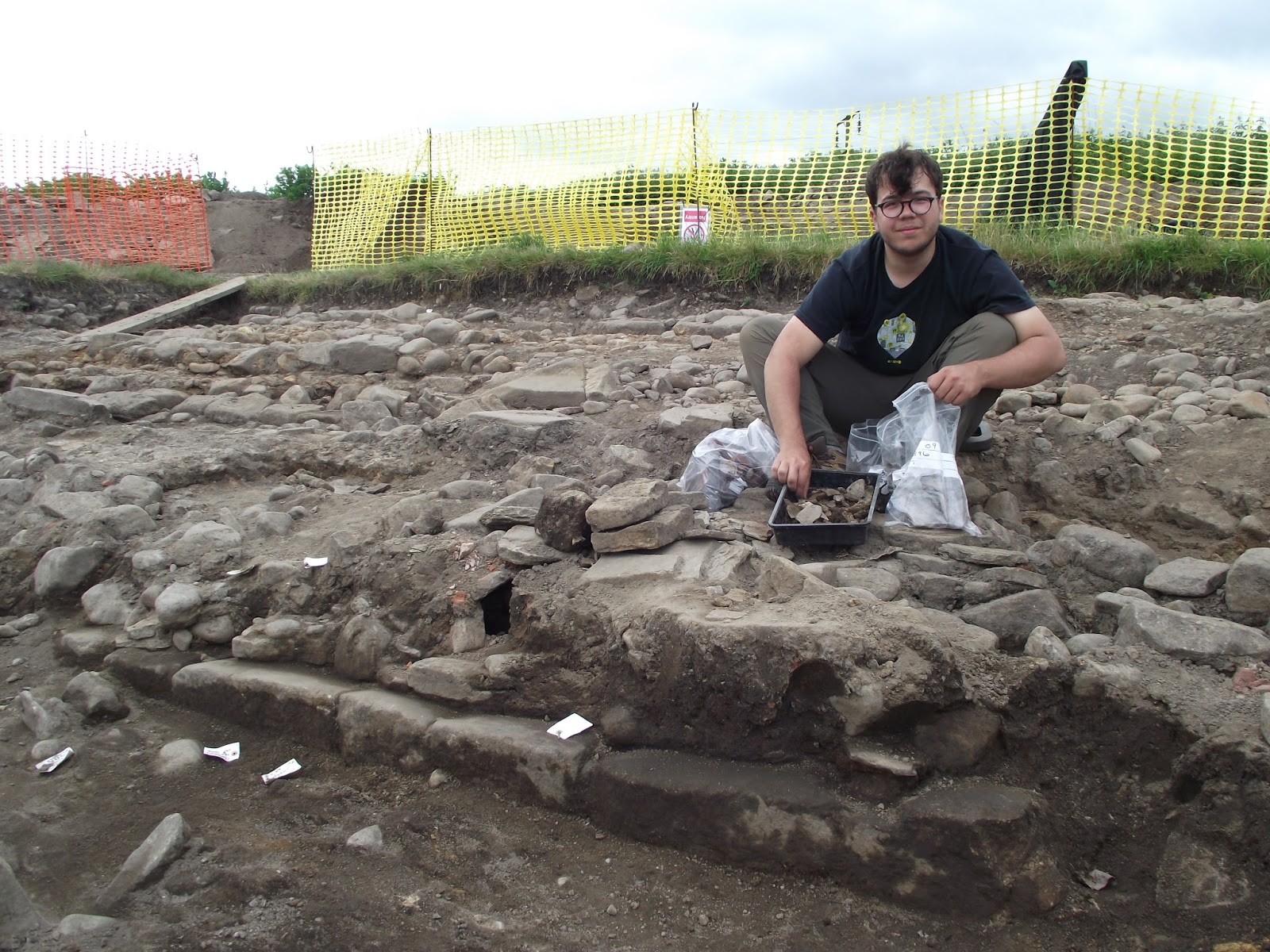
Progress is a little slower this week due to our reduced numbers- nonetheless, there have been some interesting developments. In Trench 1, we've identified a roadside gulley cut into the sub-soil alongside the northern edge of the northern intravallum road- it makes a nice change to be excavating negative features rather than wall chasing. Along the edge of the barracks, we've had more lines of our strange post-hole voids appearing marking possible internal or external walls. We're also finding yet more evidence for subsidence- Helen has been excavating a large "pit" which in fact appears to be a sunken metalled surfaced, which is cut by a drainage gully. We've also been ferreting in our road sections- in the area where we thought we'd more or less got to natural, we've now found a large stone kerb or wall running north-south...  no idea what this could be- possibly an earlier road?

In Trench 2, there is still more cleaning up of the external pavements and surfaces around the bath-house. In our small post-hole area, Stephen excavated a small stone setting packed with coal and other burnt material, with lots of splashes of copper alloy - this must be a candidate for part of a metal working hearth.Further to the east, the team are continuing to trowel through the soft grey and brown roadside layers- the presence of various stone settings all hint at something structural here, but nothing has yet resolved itself clearly

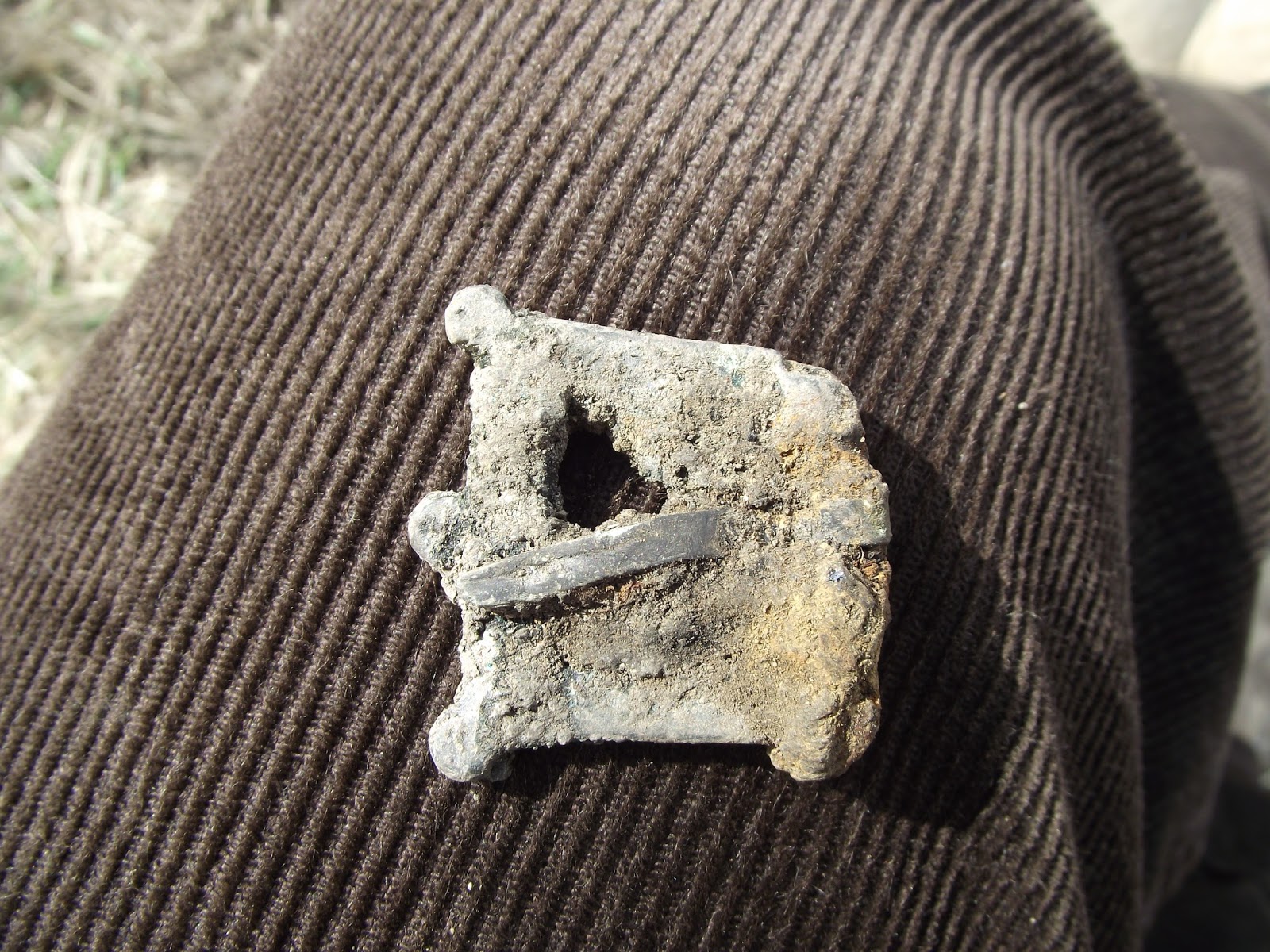
Some nice finds today- a lovely little enamelled stud found by Laura, and a strange metal grill or mount and a belt-buckle also from the area in front of the bath-house.


Tuesday, 23 June 2015

Binchester 2015: Day Seventeen

I'm afraid I was not on site today as I was attending the graduation of our latest batch of freshly minted 3rd year archaeology students. This means I can't do a full blog entry- but it does look like I missed the discovery of some cracking finds. Michael has been digging for about five seasons, but his discovery must be the best so far- a totally complete grey-ware pot - discovered near the road in Trench 2. Nearby Margaret discovered a rather nice intaglio showing the god Mercury. A good day all round!


Monday, 22 June 2015

BInchester 2015: Day Sixteen

A rather desultory day- our numbers are lower than last week as our 1st year students have gone, and rain from lunchtime reduced the workforce even further.

Trench 1 continued the identification and excavation of drainage slots and post-holes in the barrack. There was also the beginning of an attempt to get our heads around a strange wodge of rubble sticking out in the layers beneath the bread oven in the north-west corner.

In Trench 2, more action on the south and west sides of the bath-house. On the southern side, Michael, Morris and Sue continued to reduce the layers between the building and the road, with Michael picking out some of the possible post-holes associated with a potential structure that lies in this area. Nearby, Laura started to half-section the building defined by the small post-holes and seemingly associated with evidence for metal working. This is already producing evidence of a possible central burnt feature- fingers crossed we have a nice hearth associated with the metal working. Along the side of the bath-house, it's all about the road surfaces, which are slowly being reduced.

Hopefully more tomorrow- although I'm largely off site due to attending the graduation ceremonies of our recently finished 3rd year archaeology students


Friday, 19 June 2015

Binchester 2015: Day Fifteen

A hectic morning- multiple site tours and a meeting at Auckland Castle to plot and scheme. All our archaeology students finished at lunch time as its the last day of term. This afternoon there were only our volunteers on site (even Jamie and Beckah were skiving off), so it was all strangely quiet.

Nonetheless, work continued. In Trench 1, more of the same- more rows of post-holes coming up, clearly associated with areas of pavement. These are all part of the earliest timber barrack. Matt and I measured some levels across the trench this afternoon; the levels we are excavating at seem to be at the same height as the foundation courses of the north and east curtain walls, so it is unlikely that there is much more deep stratigraphy to unpick. Nonetheless, there are still plenty  of features to dig over the coming weeks.

In Trench 2, once the students left, the bath-house was empty, although I think there are still some tasks to carry out in there, particularly some sub-floor furtling in the corridor. Along the side of the bath-house, we continue to reveal the road surfaces; in particular at the moment we are aiming to join up our road surface with the southern porch threshold. Along the south of the bath-house, our possible structure we looked at yesterday is still unclear, although we have uncovered a number of vertically pitched stones, which look like they may have formed some kind of structural base or support, although it is not clear whether this maps directly on to yesterday's proposed building. Next to it, and in the front of our post-hold structure, we're starting to uncover an interesting dump of burnt material. Excitingly, this appears to be clear evidence for metal working   - in the space of 30 minutes it produced a fragment of a crucible and a crucible lid- a couple of years ago, some mould fragments came from the same area. The burnt material seems to contain small globules of copper alloy, so it is presumably the remains of Roman bronze working, although it is uncertain as yet whether this is a secondary dump of industrial waste, or if we'll come down onto a hearth. Interestingly, this industrial activity seems to have used coal as its main fuel.


Thursday, 18 June 2015

Binchester 2015: Day Fourteen

Nearly the end of our third week, and out last full day with the students. Although the weather was overcast and a little chilly, we continued to make good progress.

In Trench 1, the team looking at the new northern stretch of road have now revealed a clear kerb/gully on the north side and need to focus on clearing the stretch between that and the northern trench edge (which doesn't quite reach to the curtain wall). In our section through the side road, it is still unclear whether or not the dark, damp layer is related to an early fort phase or not- whatever it is though, it is very different from the overlying layers of compacted road surface. Within the barrack, lots of post-holes, lots of cobbles, lots of recording...

In Trench 2, work in the bath-house was focused very much on recording and cleaning up for photographs. A similar situation was to be found to the west of the bath, where the porch was being recorded, and earlier layers of road surface were being revealed and recorded. To the south of the bath-house, the roadside features are coming up nicely- we now have what looks like a stretch of roadside walling. It could simply be a well constructed gully, but it does appear to be structural. I think it is unlikely that we have another structure squeezed between the bath-house and the road, particularly as the front aspect of the bath-house contained a series of windows which would have been blocked in by a stone structure with walls like this. My current hypothesis is that it is a northern boundary wall similar to our western boundary wall- serving to mark out the bath-house compound.

In the area to the north of the road and south of the bath, we have another possible structure. Its walls are very poorly defined, but a crude line of stones seems to define a possible clay floor surface. Personally, I remain unconvinced - I can't see how the stone settings could be structural; my best guess is that it marks a working area or outside activity area rather than a proper building. Hard up next to it to the west is the evidence for something more structural. This new building is defined by a series of the strange stake-holes that we have been spotting this year. These are voids rather than containing fills in the way a traditional post-pipe might. Nonetheless, they are clearly structural and 'real' rather than being natural features (see image at the top of the page). The lines are straight, the gaps between them are consistent and the whole assemblage is clearly aligned on the road. This is the first time we have found clear evidence for a structure without a stone foundation or superstructure and a reminder that even at a major site such as Binchester, simple timber structures were to be found around the more substantial stone buildings.


Wednesday, 17 June 2015

Binchester 2015: Day Thirteen

Another busy day, although we were hit by rain mid-morning. In Trench 1, the action continues along the northern strip. Finally, as anticipated, we've identified the roadside kerb in our section of road in the north-west corner; this replicates the pattern found in the road section further to the east. Just to the north of this, Pete has been quietly exposing more of the curtain wall, digging  a slot down to expose the off-sets and possible foundations. In the eastern road section we've started to expand the area uncovered by commencing to remove more material to its west.

Elsewhere in the barrack, there is more planning and recording, as well as further work defining our new post-holes and cleaning down the interior surfaces. We can see the complexity of the interior features in several places- particularly where several phases of stable drainage gully can be seen to clearly intersect each other as they have been recut and reworked. We've also been looking again at the eastern intra-vallum road. We've put two more slots through- the southern slot is still showing earlier road layers, but our northern slot appears to have removed all the road surfaces and has hit a black clay-silt layers which is very damp and sticky. It is not clear what this represents- it could indicate a period of disuse or perhaps represent an underlying pre-road deposit.

In Trench 2, the area of new flue-tiles in the bath-house has continued to be cleaned and now looks very nice. As far as we can tell not all the flue-pipes continued downwards- although some clearly do- inevitably the arrangement is perhaps more complex than we first anticipated. In the main room, there is still much recording to do, but there has been some more excavation, notably at the intersection of the two drainage culverts- this has shown that they appear to be contemporary.

In the areas to the south of the bath-house, Morris and Steven have been trowelling back a thick deposit which appears to be very rich in charcoal. Nearby, the others have revealed more of one of the kerb lines, as well as removing the deposits nearby. 

Along the western flank of the bath-house, there has been great movement hacking away the road surfaces, revealing a nicely metalled surface. This process has revealed more of the strange post/stake hole voids cutting through this surface - clearly marking a fence line.

After a couple of days with few interesting finds, things got a bit more interesting today, with yet another ring with an intaglio and nice metal mount from the spoil heap and some interesting glass and ceramics.