 The topsoil is now virtually complete- there was only a couple more metres to go when I left site at lunchtime. Obviously, there is still a lot of cleaning to be done, but its clear that there are a number of significant features emerging. The thing that immediately struck me was the apparent lack of layers of cobbles/stones that characterised the interior of the fort in Trench A. It does seem that we are coming down straight onto late Roman features, with less evidence for sub-/post-Roman activity. However, this may all change once we've given it a good clean. More generally, the line of Dere Street is clearly visible and a number of stretches of stone wall-lines are already apparent (as was expected). One of the first jobs for the students next week will be to give this area a thorough clean to let us begin to define the area in more detail.
Thursday, 3 June 2010
First thoughts
The topsoil is now virtually complete- there was only a couple more metres to go when I left site at lunchtime. Obviously, there is still a lot of cleaning to be done, but its clear that there are a number of significant features emerging. The thing that immediately struck me was the apparent lack of layers of cobbles/stones that characterised the interior of the fort in Trench A. It does seem that we are coming down straight onto late Roman features, with less evidence for sub-/post-Roman activity. However, this may all change once we've given it a good clean. More generally, the line of Dere Street is clearly visible and a number of stretches of stone wall-lines are already apparent (as was expected). One of the first jobs for the students next week will be to give this area a thorough clean to let us begin to define the area in more detail.

The topsoil strip continues
 Weather much better yesterday and progress is continuing apace. The plan below shows the location of the new Trench B in the vicus to the east of the fort. The trench cuts through the distinct terrace that runs along the length of the field. At the southern edge of the trench the remains of Dere Street are very close to the surface but they are more deeply buried to the north. This is probably due to the presence of the terrace, which appears to be made up of topsoil, seemingly supporting our hypothesis that this is an element of 19th century landscaping associated with the reconstruction of Binchester Hall. The weather is good again today, so we're hoping to make good progress in completing the topsoil strip and getting all the site huts and storage units onto the site in readiness for the arrival of the students next week.
Tuesday, 1 June 2010
Binchester 2010: it begins...
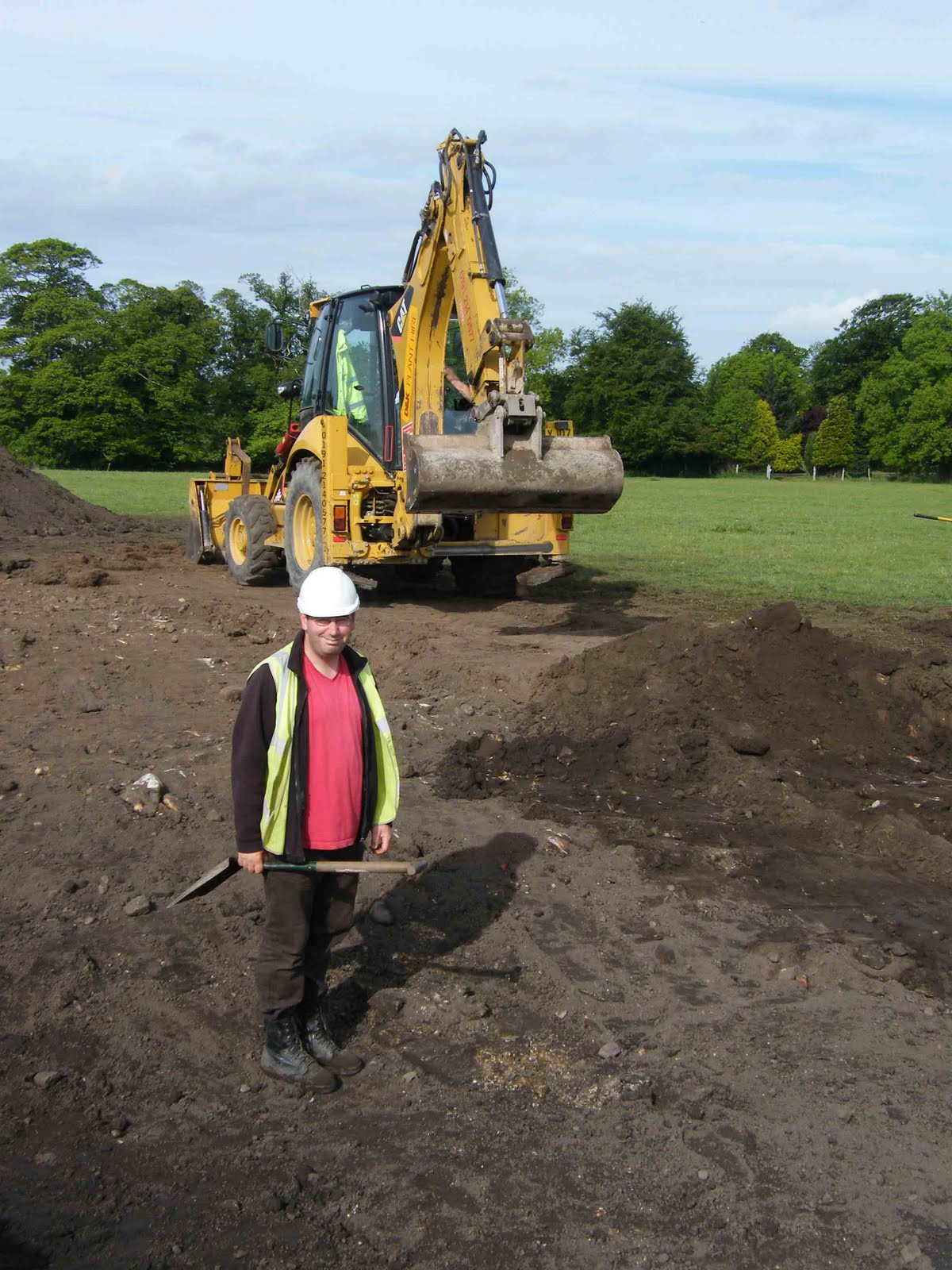
 Well, we've begun again! Today we commenced the topsoil strip for our new trench (Trench B) sited in the vicus. This is going to provide a valuable opportunity to get stuck into the important archaeology of the civillian settlement that surrounds the fort. The area being opened up is a section to the north of Dere Street, which will allow us to examine an area of street frontage and the properties running off it. Inevitably the weather was awful, but Jamie is busy supervising the digger we use to take off the topsoil, whilst the spoil is being scanned by metal dectorists to ensure we don't lose anything important from the ploughzone. As well as workig in this new area, we'll also be returning to last year's trench (Trench A) to continue the work on the late Roman barrack. Keep watching!
Tuesday, 11 May 2010
Community Archaeology at Binchester
 Following on from the Time Team investigation at Binchester Roman Fort in 2007, a major research project was initiated last year, concentrating initially on an area in the interior of the fort, the south east gateway and an area in the civil settlement. The Society was involved from the outset, and members took part in the 2009 community excavation and have recently participated in post excavation finds processing.
From 5 July to 13August 2010, there will be a chance for society members to join the community excavation again. The cost will be £5 for members, or £20 (including A.A.S.D.N. membership) for non-members. Volunteers are expected to commit for a minimum of three, or preferably five consecutive days. Prior booking is essential, for which contact David Mason, email: david.mason@durham.gov.uk
Wednesday, 5 May 2010
Archaeology in the Middle Wear Valley
 This short series of free public lectures for all ages will give local people an insight into the methods and techniques used by archaeologists to explore and understand the archaeology of the Wear Valley. Using results from the latest research in the area the development of the region from the earliest inhabitants to the Industrial Revolution will be looked at through the lens of archaeology.
 Introduction to archaeological techniques May 26th
From Hunter-Gatherers to the Industrial Revolution June 2nd
Recent research and future plans June 9th
Venue: Elgar Room, Bishop Auckland, Town Hall, 7.30-9.00
No need to book. For further information please contact Dr David Petts, Dept. of Archaeology, Durham University 0191-33 41166; d.a.petts@durham.ac.uk
Thursday, 25 February 2010
Latest developments
Just a quick note to flag up the latest developments on the project. First, we're nearly finished with the processing of the pottery and bone from the 2009 season thanks to the tremendous efforts of members of the Durham and Northumberland Archaeological and Architectural Society, who have performed wonders. Second, we're in the middle of finalising plans for the 2010 excavation season, which will run roughly during June and July this summer. We'll provide more details once we have them. Finally, whilst I was down in London yesterday for a meeting of the Archaeology Committee of the Roman Society I was able to spend some time in the British Library. Whilst I was mainly working on stuff related to another research project of mine, I also had a chance to do a bit of chasing archival material related to Binchester, and I was able to track down a late 18th century view of Binchester as seen from Bishop Auckland. It was drawn by the Swiss artist Samuel Grimm in the 1780s during a tour he took through County Durham and Northumberland. It shows Binchester Hall and its surroundings, although little can be seen of the Roman remainsa at the site. I shall arrange to have a scan made of the image and when I get it, I'll pop a copy on the blog.
Tuesday, 2 February 2010
Finds Processing
 One of the key tasks during the post-excavation process is the basic washing, marking and recording of the artefacts. This season we recovered roughly 7500 fragments of pottery, 2000 fragments of Ceramic Building Material (both of mixed Roman and medieval date), as well as around 3000 fragments of animal bones. This is on top of all the metal objects and small finds which were found during the ten weeks of the dig. All this pottery and bone needs to be washed clean and then marked with the site code and context number, so we know where it came from. This is, not surprisingly, a labour intensive process. Until now the bulk of this work has been taken up by Durham students. However, today saw a new workforce coming on line- members of the Durham and Northumberland Archaeological and Architectural Society, one of our key project partners. Many of them spent time digging with us during the summer and are now taking the chance to see what goes on out of season. Later this year some of them will also have the chance to become involved in exploring the environmental archaeological aspects of Binchester.
Subscribe to:
Posts (Atom)


